10 Common Academic Writing Mistakes and How to Avoid Them
Academic writing is a skill that separates good students from great scholars. Yet even talented thinkers lose grades due to preventable errors. This 1500-word guide dissects the 10 most common mistakes - weak Thesis, poor organization, plagiarism traps, citation chaos, and more - with practical fixes guaranteed to elevate your writing from B to A+ territory.
Master these principles and your papers will demonstrate the clarity, rigor, and sophistication professors seek.
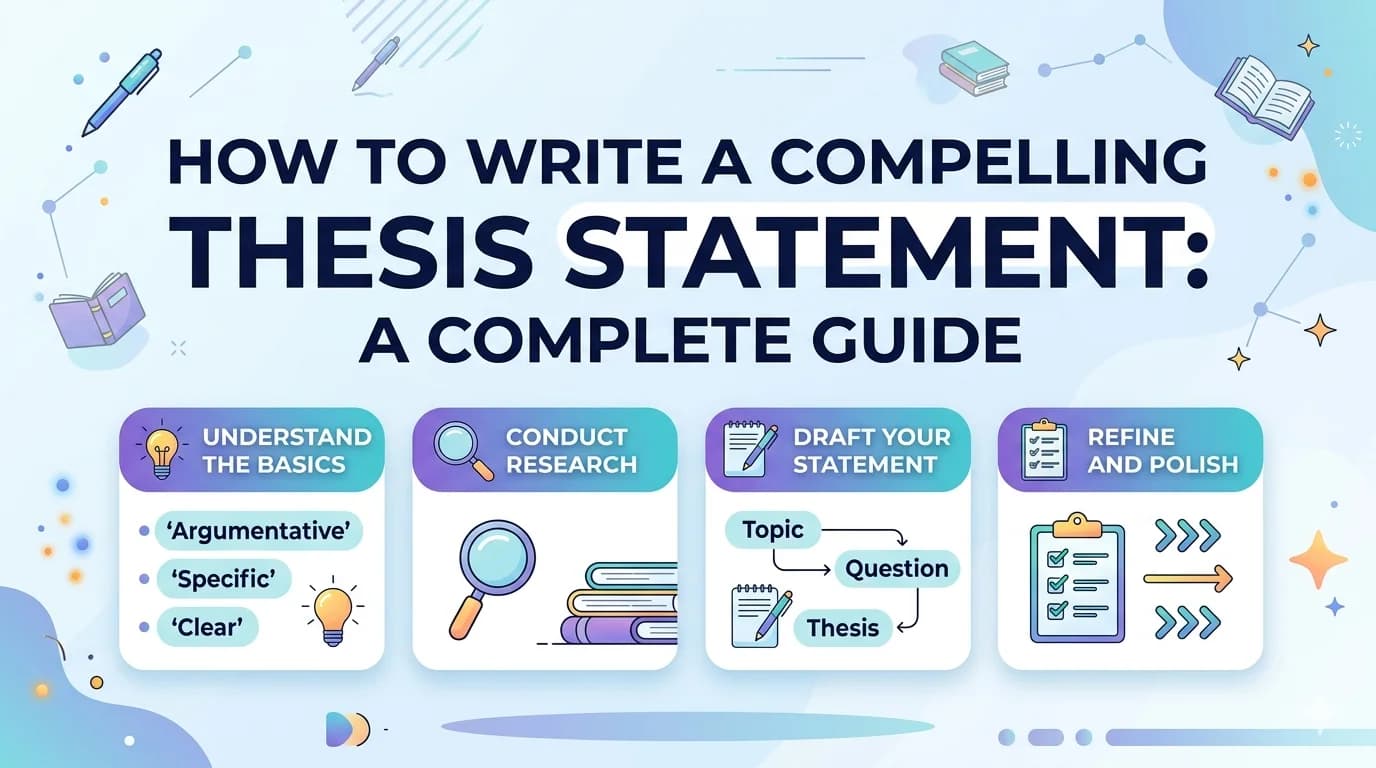
Mistake 1: Weak or Missing Thesis Statement
The Problem: Your thesis is the GPS for your paper. Without it, readers (and graders) get lost. Most students write vague generalities or announcement statements.
Weak Examples:
"Technology is important to society."
"In this paper I will discuss climate change."
"Dogs are good pets."
Fatal Flaws:
- Not arguable ("Paris is France's capital" = fact)
- Too broad ("Technology impacts everything")
- Lists without analysis ("I will discuss A, B, C")
Perfect Thesis Formula:
[Specific claim] + [3 supporting points] + [counterargument if sophisticated]
"Although smartphones improve connectivity, they harm adolescent mental health through sleep disruption (25% reduction), attention fragmentation (35% task switching), and social comparison (42% anxiety correlation)."
Fix Protocol:
- Specificity Test: Can you name 3 pieces of evidence?
- Arguability Test: Can reasonable people disagree?
- Scope Test: Fits 8-15 pages?
- Preview Test: Outlines paper structure?
Grade Impact: Weak thesis = automatic B- ceiling.
Mistake 2: Poor Organization and Structure
The Problem: Brilliant ideas buried in chaotic paragraphs. Professors spend 60% of grading time on structure.
Symptoms:
- Paragraphs > 150 words
- No topic sentences
- Ideas jumping between sections
- Conclusion introduces new material
Gold Standard Structure:
Introduction (10%): Hook → Background → Thesis + roadmap
Body Paragraph Template (80%):
├── Topic sentence (claim)
├── Evidence (quote/paraphrase/data)
├── Analysis (SO WHAT?)
└── Transition
Counterargument Paragraph
Conclusion (10%): Thesis restate → Summary → Implications
Paragraph Golden Ratio: 25% topic → 50% evidence → 25% analysis
Organization Checklist:
[ ] Outline before writing
[ ] Every paragraph has topic sentence
[ ] 1 idea per paragraph
[ ] Transitions between major sections
[ ] Reverse outline matches thesis
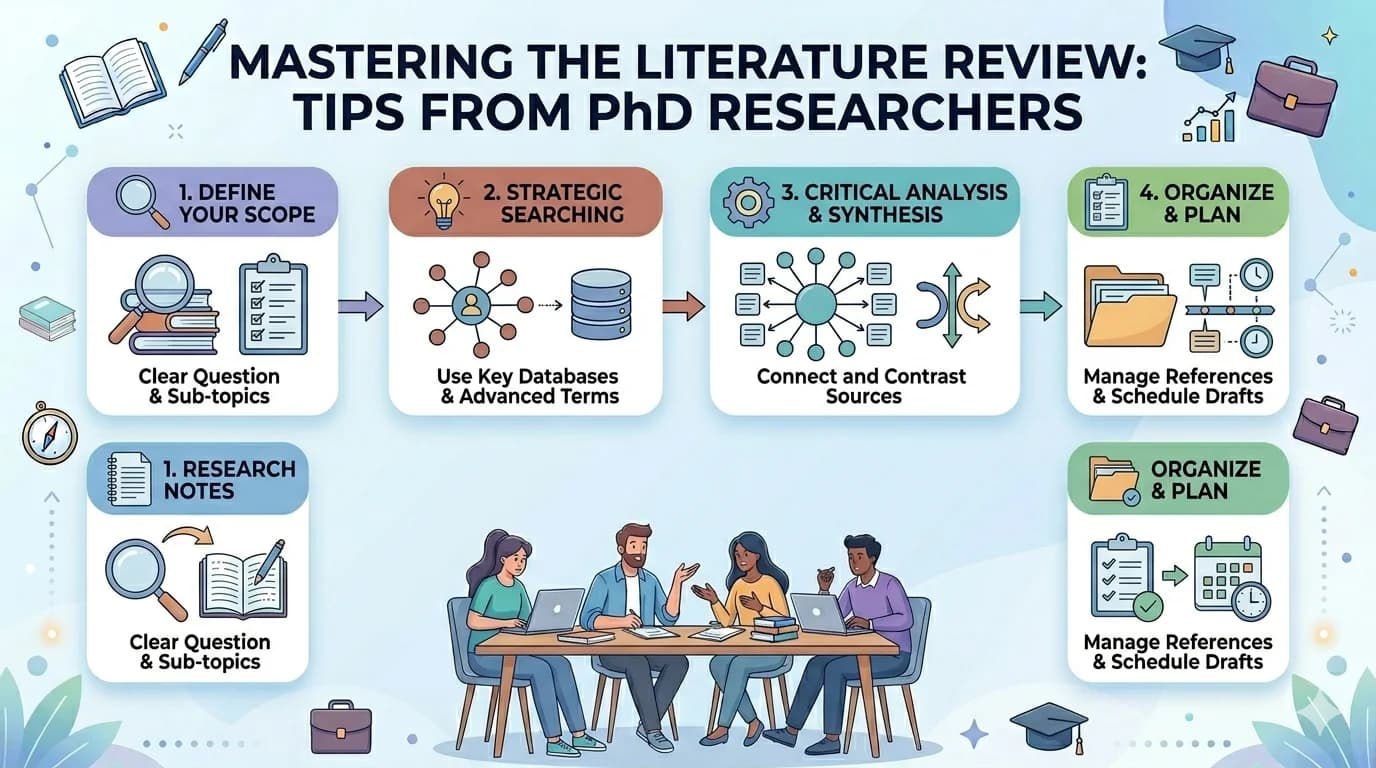
Mistake 3: Inadequate or Poor-Quality Research
The Problem: Professors can spot weak research in 30 seconds. "Google it" sources kill credibility.
Source Quality Hierarchy:
Level 1: Meta-analyses/systematic reviews
Level 2: Peer-reviewed journals (5 years max)
Level 3: Academic books (10 years max)
Level 4: Reputable news (NYT/WaPo)
AVOID: Wikipedia, blogs, forums
Minimum Sources:
| Paper Length | Academic Sources |
|---|---|
| 1000 words | 8-12 |
| 2000 words | 15-20 |
| 5000 words | 25-35 |
Research Audit Questions:
- 70% peer-reviewed?
- Recency appropriate?
- Variety of perspectives?
- Primary sources when possible?
Database Priority:
1. Google Scholar (cited by)
2. Discipline-specific (PsycINFO, ERIC)
3. Scopus/Web of Science
4. JSTOR (classics)
Mistake 4: Plagiarism (Intentional and Unintentional)
The Problem: Turnitin scores >15% trigger red flags. Unintentional plagiarism (poor paraphrasing) = same penalty.
Plagiarism Spectrum:
Direct Copy: 45% cases (quotes no citation)
Mosaic: 30% (sentence patchwork)
Paraphrase Fail: 20% (same structure)
Self: 5% (reuse own work)
Paraphrase Danger Zone:
Original: "Global warming causes sea levels to rise."
Bad: "Sea levels rise due to global warming."
Good: "Climate change contributes to elevated ocean levels through thermal expansion."
Anti-Plagiarism System:
Note-taking: [Author 2024]: "direct" → paraphrase in own words → cite
Color code: Yellow=quotes, Blue=paraphrase, Green=my ideas
Turnitin early (draft 2)
Turnitin Score Guide:
<10%: Excellent
10-20%: Quote check
20-30%: Paraphrase needed
>30%: Rewrite
Mistake 5: Weak or Missing Evidence
The Problem: Claims without support = opinion piece. Professors demand DATA.
Evidence Pyramid:
Meta-analysis (r=0.45 across 32 studies)
RCT (p<0.01, n=542)
Peer-reviewed study (Smith 2023)
Academic book (Jones Ch. 4)
News article (NYT 2024)
Your anecdote (weakest)
Evidence Integration Formula:
Introduce → Cite → Analyze → Connect
"Smith (2023) found 42% correlation (Table 2), suggesting causal direction confirmed by experimental replication (Jones 2024, p=0.002). This supports thesis claim #2."
Red Flags:
All quotes, no paraphrase
No page numbers for quotes
One source repeated 5x
News > academic sources
Mistake 6: Citation and Referencing Chaos
The Problem: Inconsistent style = sloppy scholarship. APA 7th errors alone drop 10%.
Citation Nightmares:
Wrong: "Smith said technology is good (2020)."
Right: "Technology enhances productivity (Smith, 2020)."
Wrong: Retrieved from URL (stable links)
Right: DOI hyperlink
APA 7 Quick Rules:
Books: Author. (Year). Title. Publisher. DOI
Journals: Author. (Year). Title. Journal, vol(issue), pages. DOI
No DOI: Database name or no URL
20+ authors: First 19 + ...
Reference Audit:
[ ] Hanging indent
[ ] Alphabetical
[ ] DOI hyperlinks work
[ ] Sentence case titles
[ ] Italics correct
Mistake 7: Informal Language and Tone
The Problem: Contractions, first person, slang signal immaturity.
Casual → Academic:
I think → This paper argues
A lot → Numerous (quantify)
Kids → Undergraduate students
Thing → Phenomenon/mechanism
You know → As demonstrated
Academic Voice Checklist:
✓ Present tense literature review ("Smith finds...")
✓ Third person (no "I think")
✓ Precise vocabulary
✓ No rhetorical questions
✓ Active voice primary (passive for methods)
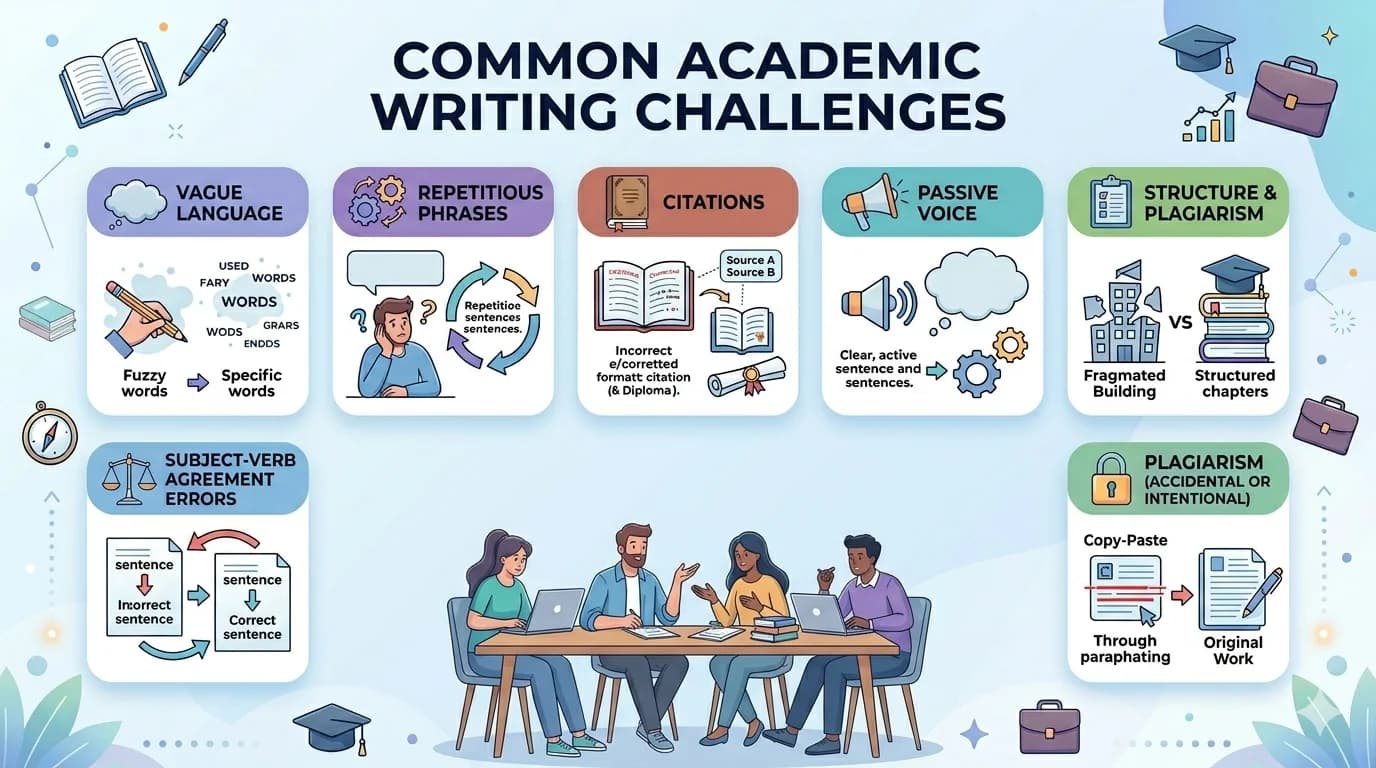
Mistake 8: Grammar, Syntax, and Style Errors
Top 10 Fixable Errors (80% grade deductions):
- Comma Splices: Independent clauses
Wrong: The study was interesting, it found significance.
Right: The study was interesting; it found significance.
- Dangling Modifiers:
Wrong: Walking home, the sunset was beautiful.
Right: Walking home, I saw a beautiful sunset.
- Subject-Verb:
Data is (singular), students are (plural)
-
Run-ons: Break 50+ word sentences.
-
Passive Overuse: Limit 20% max.
-
Fragments: Complete thoughts.
-
Parallel Structure: Reading, writing, arithmetic.
-
Apostrophes: Students' papers (plural possessive).
-
Tense: Literature present, methods past.
-
Transitions: However, therefore, consequently.
Proofreading Protocol:
Day 1: Write
Day 2: Structure check
Day 3: Grammarly Premium
Day 4: Read aloud
Day 5: Fresh eyes review
Mistake 9: Weak Transitions and Flow
The Problem: Abrupt idea jumps confuse readers.
Transition Hierarchy:
Weak: But, and, so
Good: Furthermore, consequently, nevertheless
Excellent: This limitation raises questions about...
Section Transitions:
Summary previous → Thesis next → Link evidence
"Having established theoretical foundations, empirical testing requires experimental methodology because..."
Paragraph Glue:
Last sentence → first sentence next paragraph
Mistake 10: Weak Conclusions
The Problem: Summary-only endings waste opportunity.
Perfect Conclusion ARC:
**A**: Answer thesis (different words)
**R**: Recap 3 main points briefly
**C**: Consequences/implications/future research

Example:
"Thus active learning improves retention (thesis). Experimental evidence, theoretical support, practical implications confirm this (recap). Future K-12 implementation requires teacher training (forward)."
Avoid:
New information
Questions ("so what do you think?")
Apologies ("this paper is not perfect")
Master Prevention System
Pre-Writing (30 minutes):
Thesis workshop 3 versions
Outline reverse-engineered from thesis
Source matrix (quality + relevance score)
Writing (active):
One screen paragraph rule
Evidence after every claim
Running citation count
Color code argument strength
Post-Writing (2 hours):
Reverse outline vs thesis
Turnitin (target <12%)
Grammarly + Hemingway App
Peer review checklist
24-hour break + final proofread
Technology Stack:
Zotero: Citation management
Grammarly Premium: Style + plagiarism
Hemingway App: Readability
Turnitin: Similarity
Google Scholar Alerts: Latest research
Advanced Writing Optimization
Readability Formula:
Flesch score 60-70 (professional)
Sentence length <25 words average
Paragraph <150 words
Active/passive 80/20 ratio
Professor Psychology:
First 2 pages = make or break
Paragraph 1 hooks or bores
Thesis clarity = credibility signal
Evidence quality = intelligence proxy
Organization = work ethic indicator
Publication Path:
A paper → Conference proceedings
A+ paper → Journal submission
Word Count Targets:
| Paper | Intro | Body | Conclusion |
|---|---|---|---|
| 1000 | 150 | 750 | 100 |
| 3000 | 400 | 2300 | 300 |
Final Checklist
THESIS [ ] Arguable [ ] Specific [ ] Roadmap
SOURCES [ ] 70% peer-reviewed [ ] Recent [ ] Varied
STRUCTURE [ ] Topic sentences [ ] Transitions [ ] Counterargument
EVIDENCE [ ] ICE (introduce/context/explain) every quote
LANGUAGE [ ] Academic tone [ ] No contractions [ ] Precise
GRAMMAR [ ] Read aloud test passed [ ] Grammarly 95+
CITATIONS [ ] Consistent style [ ] Page numbers [ ] DOI/URLs
CONCLUSION [ ] No new info [ ] Implications clear [ ] Memorable
FINAL [ ] <12% Turnitin [ ] Reverse outline matches [ ] Fresh eyes OK
Master these 10 fixes and your academic writing transforms from competent to exceptional. Every mistake eliminated = 5-10% grade boost. Implement systematically and watch Bs become As.
The difference between good and great academic writing? Attention to these preventable details.