Choosing the Right Research Methodology for Your Dissertation
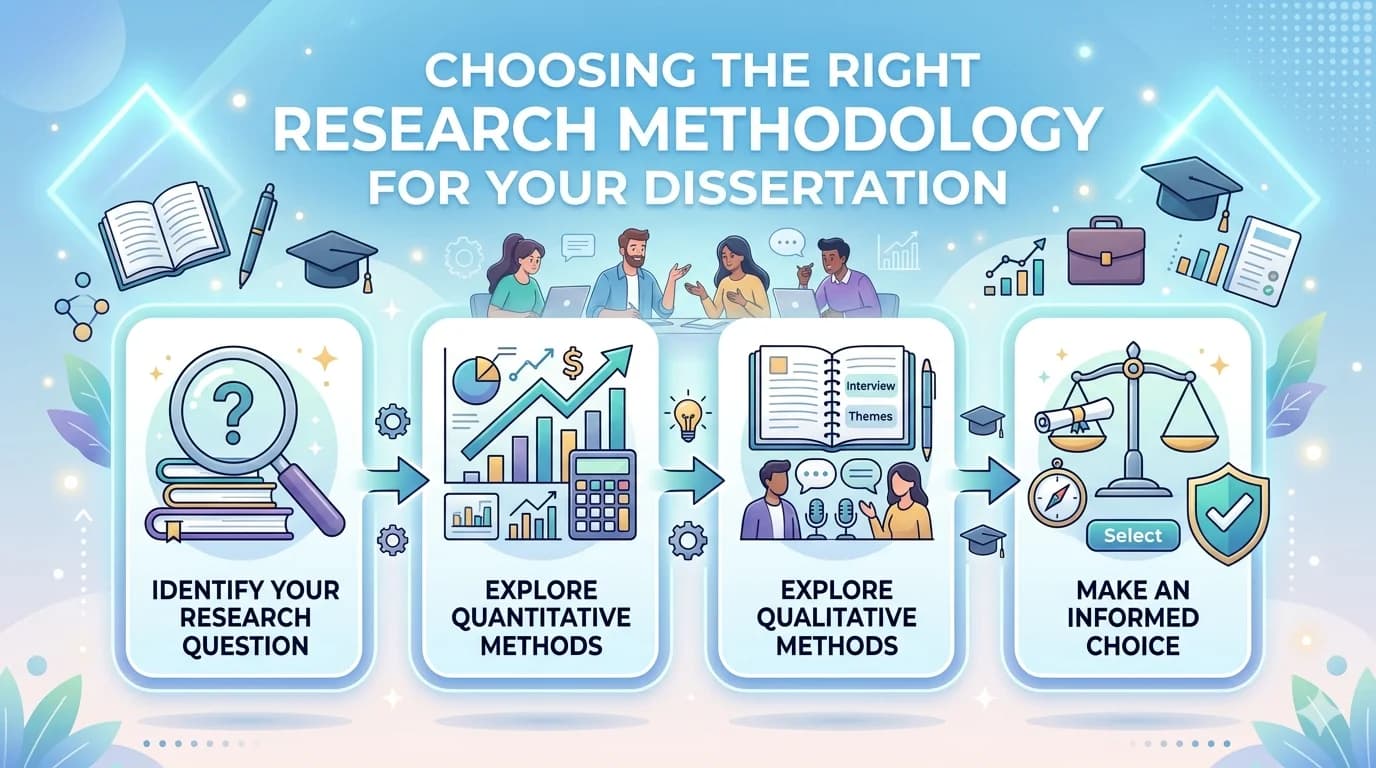
Research methodology is the backbone of your dissertation. It's not just a technical requirement—it's the framework that determines whether your research stands up to academic scrutiny. Choose wrong, and your findings are questionable. Choose right, and your dissertation becomes a model of scholarly rigor.
This comprehensive guide walks you through every aspect of research methodology selection, from philosophical foundations to practical execution. By the end, you'll know exactly which approach fits your research question, how to justify it to your committee, and how to implement it flawlessly.
Understanding Research Methodology
Research methodology encompasses the strategies, techniques, and tools you use to collect and analyze data. It's more than data collection—it's your research philosophy made concrete.
The methodology chapter typically comprises 15-20% of your dissertation (3000-6000 words for a 30,000-word dissertation). Poor methodology = rejected dissertation. Sound methodology = published papers.
Core Question: Does your methodology answer your research question in the most valid, reliable, and ethical way possible?
Qualitative vs Quantitative Research
Qualitative Research: Depth Over Breadth
Qualitative research seeks to understand phenomena through the participants' lived experiences. Perfect for "how" and "why" questions.
Key Characteristics:
- Small sample sizes (10-50 participants)
- Rich, detailed data (interviews, observations)
- Inductive approach (theory emerges from data)
- Focus on context, meaning, subjectivity
When to Use:
Research Question Examples:
"Why do teachers resist technology integration?"
"How do first-generation students experience imposter syndrome?"
"What are patients' lived experiences with chronic pain?"
Common Methods:
- In-depth Interviews: 45-90 minutes, semi-structured
- Focus Groups: 6-10 participants, moderated discussion
- Ethnography: Long-term participant observation
- Case Studies: Deep dive into single/bounded case
Analysis:
1. Transcription → NVivo coding
2. Thematic analysis (Braun & Clarke 6-step)
3. Member checking for validity
Quantitative Research: Patterns and Generalization
Quantitative research tests hypotheses through numerical data. Perfect for "what", "how much", "relationship between" questions.
Key Characteristics:
- Large sample sizes (100-1000+)
- Structured data collection (surveys, experiments)
- Deductive approach (test existing theory)
- Statistical analysis, generalizability
When to Use:
Research Question Examples:
"Does active learning improve STEM retention rates?"
"What is the correlation between study hours and GPA?"
"Does mindfulness training reduce nurse burnout?"
Common Methods:
- Surveys: Likert scales, validated instruments
- Experiments: RCTs, quasi-experimental
- Secondary Data: Existing datasets
- Longitudinal Studies: Track change over time
Analysis:
1. Descriptive statistics (means, frequencies)
2. Inferential tests (t-test, ANOVA, regression)
3. Effect sizes (Cohen's d, r)
4. Power analysis (pre/post hoc)
| Aspect | Qualitative | Quantitative |
|---|---|---|
| Sample Size | 10-50 | 100-1000+ |
| Time | 6-12 months | 3-6 months |
| Cost | High (transcription) | Low (software) |
| Generalizability | Low | High |
| Rigor | Trustworthiness | Statistical validity |
Mixed Methods: Best of Both Worlds
Mixed methods combine qualitative depth with quantitative breadth. Use when your research question requires both.
Convergent Parallel:
Data collection: QUAN + QUAL simultaneous
Analysis: Separate → Merge/Compare
Example: Survey + interviews on teacher effectiveness
Explanatory Sequential:
Phase 1: Quantitative survey
Phase 2: Qualitative explains "why" outliers
Example: Student performance survey → interview low performers
Exploratory Sequential:
Phase 1: Qualitative interviews
Phase 2: Survey validates themes across larger sample
Example: Student stress interviews → validated stress scale
Integration Challenge: The hardest part. Use joint displays:
Quantitative Result | Qualitative Explanation
r = 0.42 study-GPA | "Quality > quantity" - Student quotes
Factors Influencing Methodology Choice
1. Research Question Alignment
| Question Type | Methodology |
|---|---|
| Descriptive (what/how much) | Survey |
| Exploratory (patterns) | Correlational |
| Causal (cause-effect) | Experimental |
| Explanatory (why/how) | Qualitative |
2. Philosophical Paradigm
Positivism: Objective reality exists → Quantitative
Ontology: Single reality
Epistemology: Objective knowledge
Methodology: Hypothetico-deductive
Interpretivism: Multiple subjective realities → Qualitative
Ontology: Constructed reality
Epistemology: Subjective understanding
Methodology: Inductive
Pragmatism: What works → Mixed methods
Ontology: Practical consequences
Epistemology: Multiple methods
Methodology: Whatever answers the question
3. Practical Constraints
Time: PhD timeline typically 3 years
- Qualitative: 12-18 months data collection
- Quantitative: 6-12 months
Access: Gatekeepers control participants
University ethics → 3 months approval
Organizations → CEO signoff required
Clinical trials → IRB mandatory
Supervisor Expertise: Match your supervisor's strengths
Stats supervisor → Quantitative OK
Qualitative expert → Thematic analysis guidance
Software: Learn one well
Quantitative: SPSS/R/Stata
Qualitative: NVivo/MaxQDA/Atlas.ti
Mixed: Both
Discipline-Specific Methodologies
Social Sciences
Education: Mixed methods king
Pre/post tests (QUAN) + teacher interviews (QUAL)
Psychology: Experimental gold standard
RCTs, lab experiments, validated scales
Sociology: Ethnography, survey combinations
STEM
Biology/Chemistry: Experimental laboratory work
Control groups, blinding, replication
Computer Science: Algorithm evaluation, user studies
A/B testing, usability metrics
Engineering: Design science, prototyping
Iterative development cycles
Medicine: Systematic reviews, RCTs, meta-analysis
CONSORT/PRISMA guidelines mandatory
Humanities
History: Archival research, discourse analysis Literature: Textual analysis, hermeneutics Philosophy: Conceptual analysis, argumentation
Sampling Strategies
Probability Sampling (Quantitative)
- Simple Random: Every unit equal chance
- Stratified: Proportions maintained
- Cluster: Groups randomly selected
Power Calculation:
Sample size = [Z-score + Z-score]² × SD² / margin²
Minimum n = 30 per group for t-tests
Purposeful Sampling (Qualitative)
- Maximum Variation: Diverse perspectives
- Critical Case: Key informants
- Snowball: Hard-to-reach populations
Saturation: Stop when no new themes emerge (typically 12-20 interviews)
Data Collection Instruments
Quantitative Instruments
Survey Design (5-point Likert):
Strongly Disagree (1) → Strongly Agree (5)
Cronbach's α > 0.7 reliability
Pilot test n = 30
Experiments:
Independent variable → manipulation check
Dependent variable → validated scale
Control group → randomization
Qualitative Instruments
Interview Protocol:
1. Grand Tour question
2. Follow-up probes
3. 45-90 minutes duration
4. Audio recorded + notes
Observation Schedule:
Structured protocol + field notes
Reflexivity journal
Triangulation multiple observers
Data Analysis Roadmap
Quantitative Analysis Pipeline
1. Data cleaning → missing values < 5%
2. Descriptive stats → tables/charts
3. Assumptions check → normality, homoscedasticity
4. Main analysis → choose test power ≥ 0.8
5. Post-hoc → Bonferroni correction
6. Effect sizes → r, d, η²
7. Robustness checks → sensitivity analysis
Common Tests:
| Test | When | Effect Size |
|---|---|---|
| t-test | 2 groups | Cohen's d |
| ANOVA | 3+ groups | η² |
| Regression | Predictors | R², β |
Qualitative Analysis (Thematic)
Braun & Clarke 6 Steps:
1. Familiarize → read transcripts 3x
2. Generate codes → open coding
3. Search themes → pattern grouping
4. Review themes → member check
5. Define themes → theme model
6. Write-up → rich description + quotes
Trustworthiness Criteria:
Credibility → triangulation
Transferability → thick description
Dependability → audit trail
Confirmability → reflexivity
Ethical Considerations in Methodology
IRB Approval Process (3-6 months)
Complete Application:
1. Research question + methodology
2. Recruitment materials
3. Informed consent form
4. Data management plan
5. Risk mitigation
Common Pitfalls:
- Vague recruitment ("students needed")
- No confidentiality plan
- High-risk populations without safeguards
- No debriefing procedure
Data Security:
Raw data → encrypted
Pseudonyms → participant numbers
3-year retention → destruction protocol
GDPR compliance (EU participants)
Writing Your Methodology Chapter
Perfect Structure Template (4000 words)
1. Introduction (500 words)
   Research question recap + chapter roadmap

2. Research Philosophy (800 words)
   Ontology → Epistemology → Justification

3. Research Design (600 words)
   Approach (deductive/inductive) + rationale

4. Population & Sampling (500 words)
   Target population → selection → size justification

5. Data Collection (600 words)
   Instruments → pilot testing → validity/reliability

6. Data Analysis (600 words)
   Software → procedures → rigor checks

7. Validity/Reliability/Trustworthiness (300 words)
   Quantitative: Cronbach's α, test-retest
   Qualitative: triangulation, saturation

8. Ethical Considerations (200 words)
   IRB approval + data protection

9. Limitations (200 words)
   Proactive acknowledgment

10. Chapter Summary (100 words)
Key Justificatory Phrases
"This mixed methods approach was chosen because..."
"The sample size was determined via power analysis (G*Power)..."
"NVivo was selected for its robust mixed methods capabilities..."
"Triangulation enhances trustworthiness by..."
Real-World Case Studies
Case Study 1: Educational Technology PhD
RQ: "How does blended learning affect student engagement?" Methodology: Mixed methods convergent
QUAN: Pre/post engagement surveys (n=250)
QUAL: 20 teacher interviews + classroom observation
Integration: Themes explain survey outliers
Result: Published in Computers & Education
Case Study 2: Nursing Burnout Masters
RQ: "Does mindfulness reduce nurse burnout?" Methodology: Quasi-experimental pre/post
Maslach Burnout Inventory (validated α=0.89)
8-week mindfulness intervention
n=85 (intervention), n=82 (control)
Result: Significant reduction p<0.001
Case Study 3: Failed Dissertation (Warning)
Problem: Student chose qualitative for "how much" question
RQ: "How many students experience stress?"
Methodology: 8 interviews (wrong!)
Committee: "Descriptive statistics needed"
Result: Major revision + 6 month delay
Methodology Checklist
PHASE 1: PLANNING [ ]
[ ] Research question → methodology alignment
[ ] Power analysis/sample size calculation
[ ] Philosophical justification written
[ ] Supervisor approval secured
[ ] Ethics application complete

PHASE 2: EXECUTION [ ]
[ ] Pilot test conducted (n=10-20)
[ ] Data collection instruments refined
[ ] 100% data backup protocol
[ ] Weekly progress logged

PHASE 3: ANALYSIS [ ]
[ ] Assumptions tested (normality etc.)
[ ] Multiple analysis methods triangulated
[ ] Reflexivity journal maintained
[ ] Results cross-validated

PHASE 4: WRITING [ ]
[ ] Chapter follows template exactly
[ ] Every choice justified with citations
[ ] Limitations proactively addressed
[ ] Word count 15% dissertation
Advanced Methodology Tips
Software Mastery Priority:
Beginner: Google Sheets + Excel
Intermediate: SPSS + NVivo
Advanced: R/Python + MAXQDA
Expert: Mixed: R + Atlas.ti
Committee Approval Hacks:
- Pilot data: Show feasibility
- Literature precedent: "Following Jones (2022)..."
- Visual roadmap: Flowchart your design
- Timeline: Realistic 12-month plan
Publication Strategy:
Methodology chapter → Methods paper
QUAN results → Quantitative journal
QUAL themes → Qualitative journal
Mixed → Mixed methods journal
Your research methodology is your dissertation's foundation. Build it strong, justify every choice, execute flawlessly, and present professionally. This chapter separates good dissertations from great ones.