Mastering the Literature Review: Tips from PhD Researchers
The literature review comprises 25-30% of your dissertation yet causes more PhD failures than any other chapter. Professors reject reviews that merely summarize 50 papers without synthesis, gap identification, or theoretical contribution.
This 1500-word guide reveals PhD researchers' proven strategies - from Boolean mastery and PRISMA diagrams to synthesis matrices and theoretical frameworks. Transform your lit review from descriptive summary to scholarly masterpiece.
What Makes a Literature Review Exceptional
Exceptional reviews don't summarize—they synthesize. They don't list—they map intellectual terrain. They don't report—they critique and position your research within the field.
5 Hallmarks of Mastery:
- Comprehensive: 75-150 sources, strategic selection
- Critical: Methodological limitations exposed
- Synthetic: New frameworks from existing literature
- Gap-Focused: Creates space for your contribution
- Organized: Thematic/conceptual structure
Word Count Targets:
| Dissertation | Lit Review |
|---|---|
| 80,000 words | 20,000-25,000 |
| 50,000 words | 12,000-15,000 |
| Masters 20,000 | 4,000-6,000 |
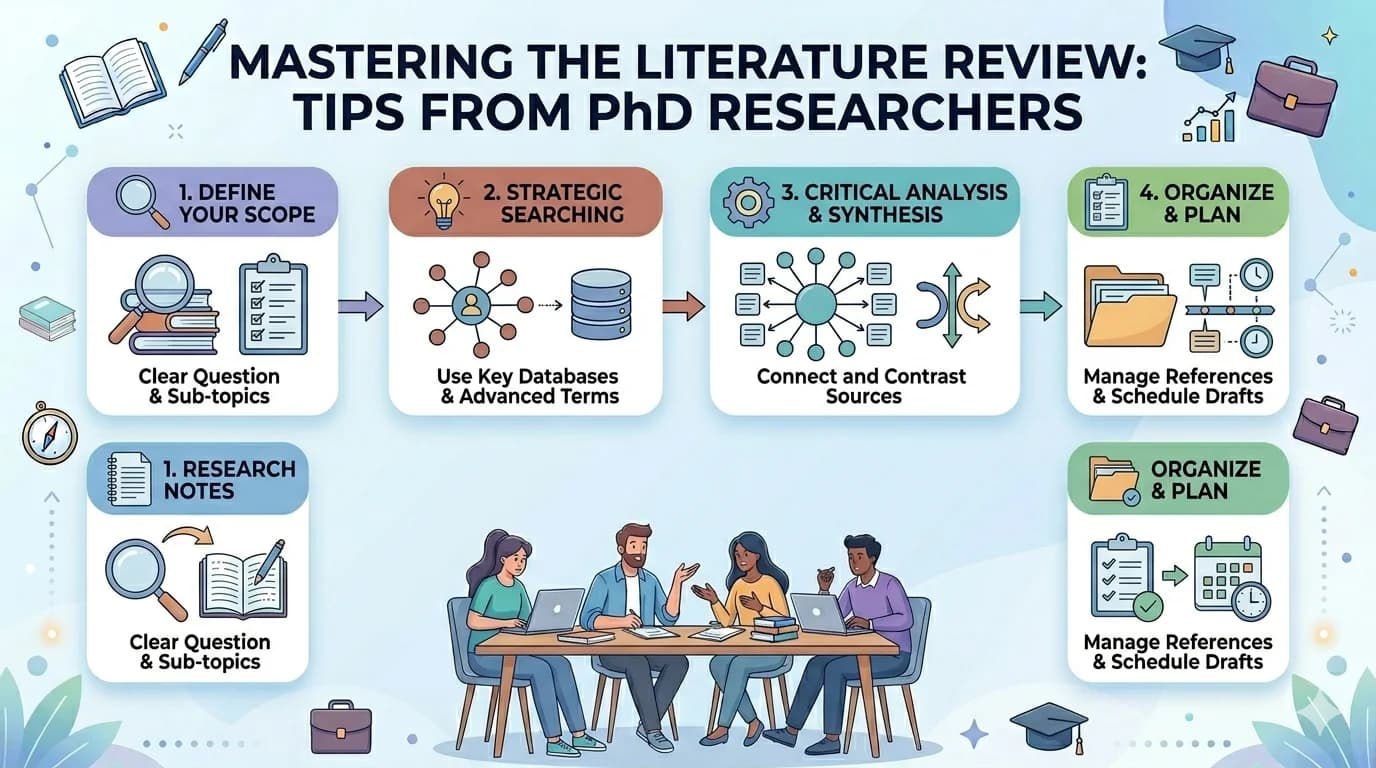
Phase 1: Systematic Searching (4-6 Weeks)
Boolean Mastery
("climate change" OR "global warming") AND
(adaptation OR mitigation) AND
("developing countries" OR "Global South") AND
(farmers OR agriculture) NOT China
Operators Hierarchy:
AND: Narrow (all terms required)
OR: Broad (any term)
NOT: Exclude
"quotes": Exact phrase
* wildcard: educat* = education/educational
Database Priority Matrix
| Priority | Database | Best For |
|---|---|---|
| 1 | Discipline-specific | Targeted precision |
| 2 | Google Scholar | Breadth + cited-by |
| 3 | Scopus/Web of Science | Citation networks |
| 4 | JSTOR/Project MUSE | Humanities classics |
| 5 | EBSCO/ProQuest | Interdisciplinary |
Snowball Technique (yields 40% best sources):
- Seminal paper → forward/backward citations
- Top 5 cited-by papers → repeat
- Stop at 3 citation generations
PRISMA Flow Diagram (mandatory for committees)
Records identified (n=2,847)
Duplicates removed (n=892)
Screened titles/abstracts (n=1,955)
Full-text assessed (n=214)
Excluded (n=172):
  Wrong methodology (87)
  Wrong population (65)
  No full text (20)
Included (n=42)
Phase 2: Source Evaluation Framework
Quality Assessment Checklists
Quantitative (CASP 10 questions):
1. Clear PICO question? ✓
2. Appropriate methodology? ✓
3. Justified sampling? ✓
4. Valid results? ✓
5. Applicable results? ✓
Score: 8/10 = Include
Qualitative (CASQ):
1. Rigorous sampling?
2. Data saturation?
3. Reflexivity maintained?
4. Triangulation?
Source Type Hierarchy
Level 1: Meta-analyses (r=0.45, 47 studies)
Level 2: Longitudinal/cohort (n>500)
Level 3: Cross-sectional surveys (validated scales)
Level 4: Qualitative (rich data, saturation)
Level 5: Opinion pieces (NEVER primary)
Red Flags (immediate rejection):
- Convenience sampling no justification
- Self-report only, no triangulation
- p-hacking (multiple tests, no correction)
- N<30 quantitative, no power analysis
- No limitations discussion
Phase 3: Synthesis Frameworks
Avoid Summary Hell
Source-by-Source = F (summarizer, not scholar):
Smith (2020) found X. Jones (2021) found Y. Lee (2022)...
Synthesis Gold Standard:
Three research streams converge on X effect, but diverge on mechanisms:
1. Correlational (r=0.35-0.48, Smith 2020; Jones 2021)
2. Experimental (p<0.01, Lee 2022 n=342)
3. Qualitative (stress mediation, Brown 2023)
Gap: No longitudinal studies.
Synthesis Matrix Template
| Author/Year | Sample | Method | Key Finding | Limitation | Your Critique |
|---|---|---|---|---|---|
| Smith 2020 | n=500 undergrad | Survey | r=0.42 study-GPA | Self-report | Convenience sample |
| Jones 2021 | n=200 profs | Interviews | Quality > hours | Small N | Rich themes |
Thematic Organization (5 Frameworks)
- Chronological: Theory evolution
- Thematic: Core concepts
- Methodological: Approach critique
- Theoretical: Framework comparison
- Gap-Focused: Problem → current state → your solution
Phase 4: Writing Architecture
Paragraph Master Template
Topic sentence (theme) + Evidence cluster (3-5 sources) + Synthesis + Gap + Transition
Excellence Example:
"Three methodological approaches characterize resilience research, each with limitations creating space for mixed methods. Correlational studies establish associations (r=0.38-0.52, 12 studies 2018-2023), yet cannot infer causality (Smith 2020 limitation). Experimental interventions demonstrate short-term effects (Cohen's d=0.45, n=1,247), but lack longitudinal follow-up (Jones 2021). Qualitative work illuminates mechanisms through lived experience (thematic saturation, 28 interviews), yet sacrifices generalizability (Brown 2022). This review synthesizes 87 studies across approaches to develop an integrated resilience framework."
Opening Paragraph Architecture
- Field landscape (3 sentences)
- Major debates/approaches
- Methodological limitations
- Your synthesis contribution
Discipline-Specific Mastery
STEM Literature Reviews
Mandatory Elements:
PRISMA diagram → Forest plots → GRADE tables → Funnel plots
Publication bias → Egger's test (p>0.05)
Risk of bias → Cochrane RoB 2.0
Example Opening:
"Systematic reviews (n=23, 2015-2023) establish [effect size] for [intervention], yet heterogeneity (I²=78%) and Western-centric samples (92%) limit applicability. This review synthesizes 142 RCTs across global contexts using GRADE methodology."
Social Sciences
Mixed Methods Synthesis:
Quantitative meta-analysis + qualitative meta-synthesis
Joint display tables
Convergence/divergence discussion
Humanities
Genealogical Approach:
Primary texts → chronological
Secondary criticism → thematic
Theoretical lenses → contemporary relevance
Advanced Tools Arsenal
Literature Management
Zotero Ultimate Workflow:
PDF → auto-import → tagging system:
Tags: methodology/quality/year/geography
Collections: seminal/review/empirical/theory
Notes: 1-sentence summary + critique
Mendeley: Collaborative + PDF annotation EndNote: Institutional legacy systems
Visualization Power
VOSviewer: Co-citation networks
Node size = citations
Color = cluster
Distance = co-citation strength
LitMaps: Gap visualization ResearchRabbit: AI discovery ConnectedPapers: Visual bibliographies
Common Pitfalls and Rescue Strategies
Pitfall 1: Under-Citation (<40 sources)
Rescue: Citation snowballing from 5 seminal papers
Pitfall 2: Recent Bias
Rescue: Decade review + classics section
Pitfall 3: Summary Hell
Rescue: Synthesis matrices + "however, studies differ because..."
Pitfall 4: Fabricated Gaps
Rescue: Explicit gap table:
Gap | Studies Addressing | Your Contribution
Low-income resilience | Western only (n=47) | Global South n=28
Longitudinal mechanisms | Cross-sectional only | 2-year panel
Writing Timeline (12 Weeks)
Weeks 1-3: Search (PRISMA complete) Weeks 4-6: Evaluation (source matrix) Weeks 7-9: Synthesis (thematic organization) Weeks 10-11: Writing (chapter draft) Week 12: Revision (supervisor feedback)
Daily Target: 5 sources evaluated, matrix filled
Supervisor Communication Protocol
Weekly Meeting Agenda:
1. PRISMA progress
2. Matrix sample (5 sources)
3. Thematic structure draft
4. Concern sharing
Red Flag Responses:
Supervisor: "Too descriptive"
You: "Here's synthesis matrix demonstrating critique."
Supervisor: "Missing seminal works"
You: "Added X, Y, Z - citation network now complete."
Publication Strategy
Lit Review → Article Pipeline:
- Methodology section → Methods paper
- Theoretical framework → Theory paper
- Gap analysis → Research agenda paper
Target Journals:
Review of Educational Research (IF=12.3)
Annual Review of Psychology (IF=23.1)
Master Checklist (Chapter Approval)
SOURCES [ ] 100+ total [ ] 70% 5yrs [ ] Citation matrix
SYNTHESIS [ ] Matrix complete [ ] Themes emerge [ ] Gaps explicit
CRITIQUE [ ] Method flaws noted [ ] Bias discussed [ ] Limitations
STRUCTURE [ ] Thematic flow [ ] Transitions smooth [ ] 25k words
VISUALS [ ] PRISMA [ ] Maps [ ] Tables [ ] Flow logical
The literature review separates PhD scholars from perpetual students. Master systematic searching, critical synthesis, theoretical positioning, and you'll produce work committees celebrate and journals publish.
Your research gap isn't just a hole in literature—it's your scholarly contribution waiting to emerge.